9-8 Reading
Assignment:
pp. 11-13 - entries on Meter, focusing specifically on understanding the concept of Nonmetrical, and Texture, focusing specifically on Monophony
pp. 15-16 - entry on Score
pp. 19-20 - entries on Tone Color/Timbre and Genre
pp. 53-54 - entry on Mass
p. 58-60 - entry on Plainchant
p. 65 - entry on Anonymous
Meter
Duple meter
- ex. 2/4, 2/8, 2/2
- accented, unaccented
- heavy, light
- Marches
Triple meter
- ex. 3/4, 3/8, 3/2
- Accented, unaccented, unaccented rythmn
- Heavy, light, light
- Waltzes & other dances
Quadruple meter
- 4/4, etc.
- Heavy, light, somewhat heavy, light
- Also called common time
Compound meter
- A recurring pattern of accented/unaccented beats that repeats in a way that can be perceived as either duple or triple
- Ex. silent night (fast: duple, slow: triple)
Non-metrical
- Doesn't have a recurring pattern of beats or meter
- Ex. Gregorian chant
Mixed Meter
- When a song has one meter & then shifts to another
Irregular meter
- When a meter is not divisible by 2 or 3
Texture
Texture is the means by which melody, harmony, and rhythm are combined in a composition.
Monophony
- A single melody line with no harmony
- For example, whistling or singing in the shower
Homophony
- A prominent melody enhanced/supported by other musical material, like chords
- For example, hymns and patriotic songs
Polyphony
- Two or more melody lines that are equal in importance.
- Two subcategories:
- Imitative polyphony: a line of melody that gets "echoed"
- Non-imitative polyphony: each line has it's own separate, contrasting melody
Score
Used to describe a printed piece of music.
Tone color/timbre
- Is different than mood
- Describes the quality of sound
- Affected by the way vibrations are created
- Could be smooth, harsh, nasal, mellifluous, toad-like
Mass
- At first mostly monophonic plainchants
- Half-way through the Middle Ages, organa also became popular
- Typically a capella
- Many different musical numbers within mass, but not connected like movements
Plainchant
- Also known as Gregorian chant, plainsong, or chant
- Monophonic
- Nonmetrical
- Church modes
- Latin text
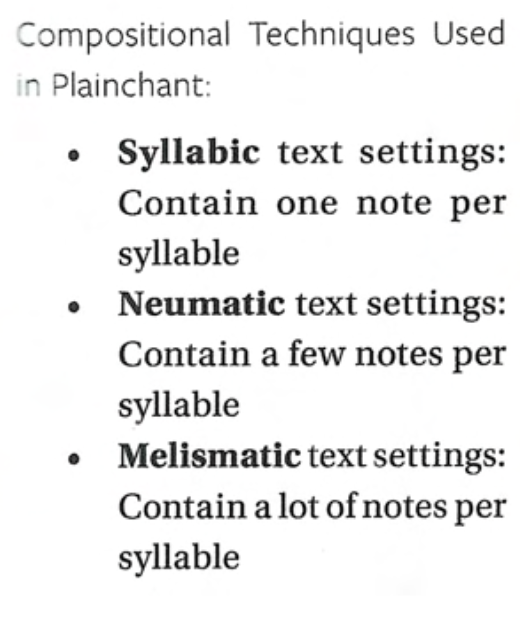
- Types of plainchant:
- Recitation: one pitch is used with small deviations. monotonous but calming.
- Responsory: one singer sings a phrase of music and the rest of the singers repeat
- Nonresponsory: no call and response effect
- A Capella
- Only really composed in the Middle Ages
Anonymous
- In the middle ages, many composers remained anonymous for religious reasons - they wanted to glorify God, not themselves.
- In secular music, some composers felt like composing put them at a lower status level, so they remained anonymous.