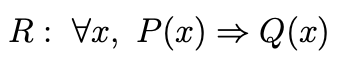
Another way to think about this theorem is that if by assuming we can reach some false statement, then R must have been true after all.
There are some limitations:
When you assume you are working in an imaginary world.
It can be difficult to find the contradition within .
The negation of
is:
An easy way to remember what to assume when proving an im- plication by contradiction is that you have the same assumptions as in both a direct proof and a contrapositive proof.
First, sometimes one can tell that a result could be proved by contradiction because the statement R itself has some negative sounding words. For instance, in this section we proved the following statements R:
• There is no smallest positive rational number.
• The number 2 is not rational.
• If x is even, then 2 does not divide .
Try to prove w/o contradiction first!
In Class Practice
: There is no smallest positive rational number. : There exists a smallest positive rational number.
Assume, by way of contradiction, that there exists a smallest positive rational number . Now consider the number . Since is a rational number, is also a rational number and . But , which is a contradiction.
:
Proposition: Let . If , then .
Proof: By way of contradiction, assume there exists such that and . Thus for some and for some .
Proposition: Given , if is odd, then is odd.
Proof: By way of contradiction that is odd and is even. Thus for some . We find
which is odd. This contradicts our assumption that is even.
Proposition: If is even, then is not the sum of three integers with an odd number of them being odd.
Proof: Let . By of contradiction, assume that there exists such that is even and is the sum of three integers with an odd number of them being odd. There are two cases:
Case 1: Assume where, without loss of generality, is odd and are even. Hence , where .
Thus
HW 9
Ben Finch
E 9.1
T
T
F
T
T
F
F
T
F
T
T
T
F
F
T
F
The table does indeed verify that the only row where is false and is true occurs when is true.
E 9.2 Proposition: Given , if is even, then is odd.
Direct Proof:
Let . We work directly. Assume is even, thus for some . Hence, . We find
is an odd integer.
Contrapositive Proof:
Let . We work contrapositively. Assume is even. Thus for some . We find is an odd integer.
Proof by Contradiction:
Assume, by way of contradiction, that both and are even. Thus and for some . Plugging the two equations into each other, we get . Therefore, is even, which is false. Thus, the original implication is true.
E 9.3 Proposition: Given with , then is even or is even.
Proof.
Assume, by way of contradiction, that and that is odd and is odd. Thus and for some . We find
which indicates that is also even, which implies that is even (since if a number's square is even, then it must also be even). Thus for some . Subbing in for yields:
which suggests some odd integer is equivalent to some even integer, which is false. Thus the original implication is true.
E 9.4 Proof:
Assume, by way of contradiction, that . We can then write for some , with in lowest terms. By squaring and clearing the denominators, we have . Thus and hence . So for some . Plugging for in the original equation, we find
Thus, and hence . However, now and are even, which contradicts
the fact that was assumed to be in lowest terms. Hence is irrational.
E 9.5 Proof:
Assume, by way of contradiction, that . We can then write for some , with in lowest terms. By cubing and clearing the denominators, we have . Thus and hence (by proposition 8.5). So for some . Plugging for in the original equation, we find
Thus, and hence (by a proof in the book). However, now and are even, which contradicts the fact that was assumed to be in lowest terms. Hence is irrational.
E 9.6
Assume, by way of contradiction, that is rational, is irrational, and is rational. We can then write and for some (where ). We find
where and are integers (and ). Thus can be expressed as a rational number, which contradicts our assumption that is irrational. Thus, our assumption that is rational must be false. Therefore, is irrational if is rational and is irrational.
E 9.7
Assume, by way of contradiction, that is rational & , is irrational, and is rational. We can then write and for some (where ). We find
which is rational (since the product of any two rational numbers is also rational). This contradicts our original assumption that is irrational. Therefore, if is rational (and ) and is irrational, then is irrational.
E 9.8
Assume, by way of contradiction, that there is a smallest positive irrational number . Now consider the number . From exercise 9.7, we know that if we multiply a non-zero rational number () and an irrational number (), we will get an irrational number. This contradicts our assumption that is the smallest positive irrational number since we have found a smaller positive irrational number . Thus we find that there is no smallest positive irrational number.
E 9.9
Let .
Assume, by way of contradiction, that . We can simplify the equation to . Since and are integers, we can assume is also an integer, since the product of two integers is an integer. However, if we divide both sides of the equation by we get , which is not an integer. Thus our original assumption that there exists some integer and such that is false.