Let and be variables, both with the same domain R. We may define the open sentence
.
You can combine open sentences with logical connectives
Quantifiers
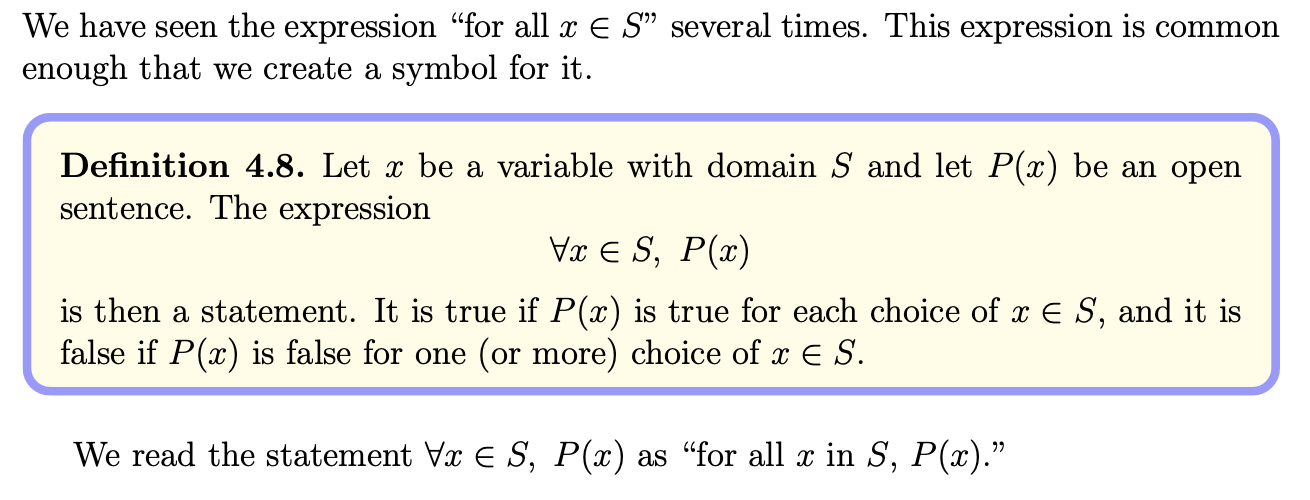
The universal quantifier
is the universal quantifier; the expression makes the assertion that the open sentence P(x) is universally true for any x in the domain S.
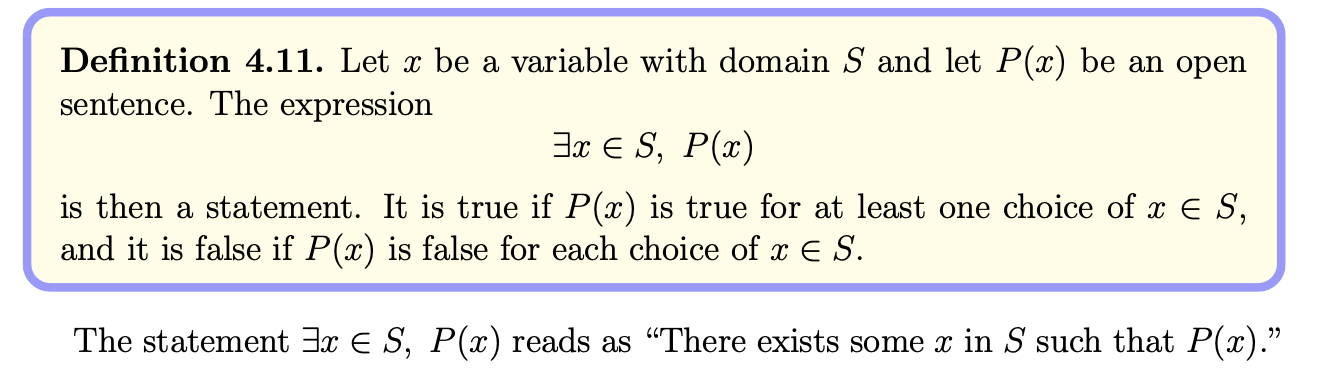
The existential quantifier
In class practice
All real numbers
HW 4
Ben Finch
E 4.1
, is even.
a)
b)
c) for some in
Q
P
R
¬R
T
T
T
F
F
F
F
T
T
F
F
F
T
T
T
F
T
T
T
F
F
T
F
F
T
T
T
F
F
T
T
F
F
F
F
F
T
F
F
F
T
T
F
F
T
T
F
F
F
F
F
F
T
F
T
T
d) Logical equivalence:
Beginning statement:
A => B is equivalent to ¬A ∨ B
De Morgan's Laws
Therefore: or is odd
E 4.2
The statement "If x is an odd integer, then is an odd integer" is logically equivalent to "x is an even integer or is an odd integer"
1: false - 1 is not an even integer nor is an odd integer.
2: true - 2 is an even integer.
3: true - is an odd integer
4: true - 4 is an even integer
5: false - 5 is not an even integer nor is an odd integer.
6: true - 6 is an even integer
The open statement is false since there are some values (for example 1 & 5) for which is false.
E 4.3
The statement Q(x): If is an even integer, then is an odd integer is logically equivalent to " is an odd integer or is an odd integer"
1: true - 1 is an odd integer.
2: true - is an odd integer
3: true - 3 is an odd integer
4: true - is an odd integer
5: true - 5 is an odd integer
6: true - is an odd integer
The statement appears to be true based on the values tested.
E 4.4**
E 4.5
a)
b) is odd is odd
c)
d
e)
f)
g)
h)
E 4.6
a) There exists some value in the real numbers such that
b) For all values that are integers, is even if and only if is even
c) For all values in the real numbers, if then .
d) For all values in the real numbers, if then
e) There exists some value in the rational numbers such that
f) For every real number , there exists an integer and a number in the range 0 (inclusive) to 1 (not inclusive) such that is the sum of and .