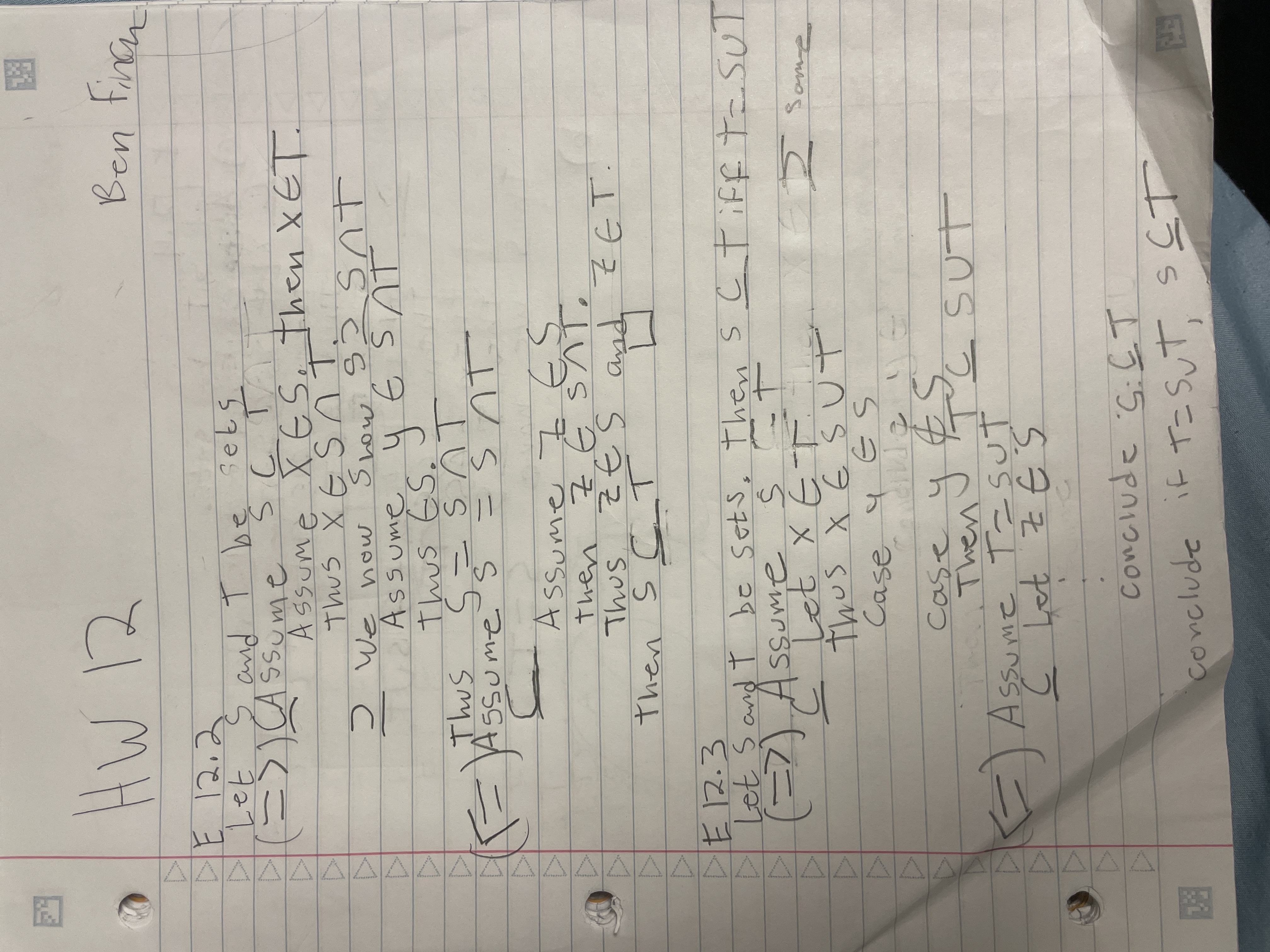
Proof. Let S and T be sets. We work directly. Assume . Let . Then since . Thus . Hence .
Proposition. Given sets and , we have iff .
(=>) Assume .
() Let ... conclude
() Let ... conclude )
<= Assume
() Let ... conclude
Proposition..
Proof. We work contrapositively. Assume . Show .
Proposition. Let and be sets. If and , then .
Proof. We work contrapositively.
Assume that .
... conclus
Proposition. Theorem: Given four sets A, B, C, D. If and , then x x .
Proof. Let A, B, C, D be sets. We work directly. Assume and . Let x B. Then and . Then and . Thus x D.
HW 12
Ben Finch
E 12.1
Proposition. For sets , prove that if , then .
Proof. Assume that . Therefore, by definition of subset, every element that belongs to also belongs to .
Let be an arbitrary element of . Because , we know that . By definition of intersection, and . Therefore, every element of is also an element of , so .
An example of when the converse fails:
Consider the sets A = {1, 2, 3}, B = {1, 2, 3, 4}, C = {5}. Thus we have but not .
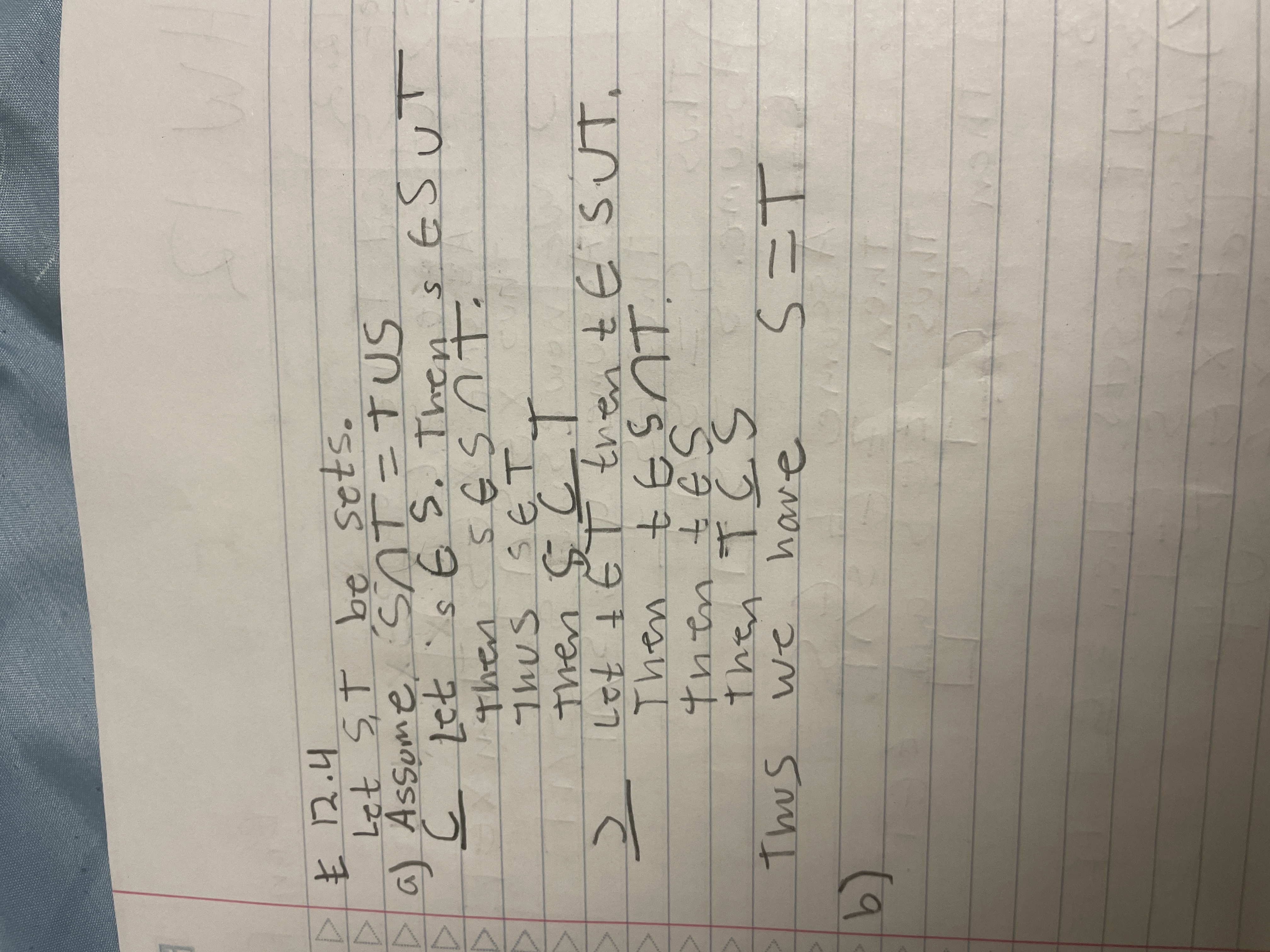
E 12.4b Proof.
We work directly. Assume x = x .
Let x . Thus, per our assumption, x . Then and . Thus . Then and . Thus we have . Thus .
E 12.5 Proof.
(=>) We work directly. Assume . Then
(<=) We work contrapositively. Assume .
Case 1: If there exists an and , then will be in , but . Therefore, .
Case 2: If there exists a and , then will be in , but y Therefore, .
In either case, we see that .
Thus if and only if .
E 12.6 Disproof.
Fix and . Then, . However, .
So the initial claim is false.
E 12.7
Thus, = {(a, b) | and b ∈ S}.
Assume that there exists an element in .
Then, by the definition of the Cartesian product, for some and some
However, by definition, the empty set has no elements. Therefore, there cannot be any element 'a' in the empty set.
Thus, there can be no elements in
Hence, .
E 12.8
Proof.
(=>)
If , there are no elements in to form ordered pairs with elements of . Similarly, if , there are no elements in to form ordered pairs with elements of . Thus, in either case, .
(<=)
Assume that neither nor are empty. Then there exists at least one element in each set. Denote them as and . By the definition of Cartesian product, there should be an ordered pair in . But we've assumed , which means there are no such ordered pairs, leading to contradiction. Therefore, if , then or .
E 12.9
Outline:
Start by defining the Cartesian product and , as well as what it means for to be a subset of .
Assume that and .
Show that for any element in set , there exists an element in set such that is in .
Since , this means is also in , implying that is in .
Therefore, .
Proof:
Per the definition of the cartesian product means that means every pair in is also in . Suppose that and . For any element in set , there must exist an element in set such that , since . As , this means , which implies that . Thus, for every , we have shown that . Therefore, .
If we remove the hypothesis that :
If is empty, then will also be empty (since there are no elements in to pair with elements in ). The empty set is a subset of every set, including . This does not provide any information about the relationship between and . Therefore, the statement "if , then " would not necessarily hold if could be empty.
E 12.10
The converse of the statement is: Given four sets A,B,C,D, if , then and .