Proof By Cases
Some problems can be broken down into a finite set of cases:
- Integers are even/odd
- Real numbers can be rational or irrational.
- etc
You can do some proofs by considering all possible cases separately

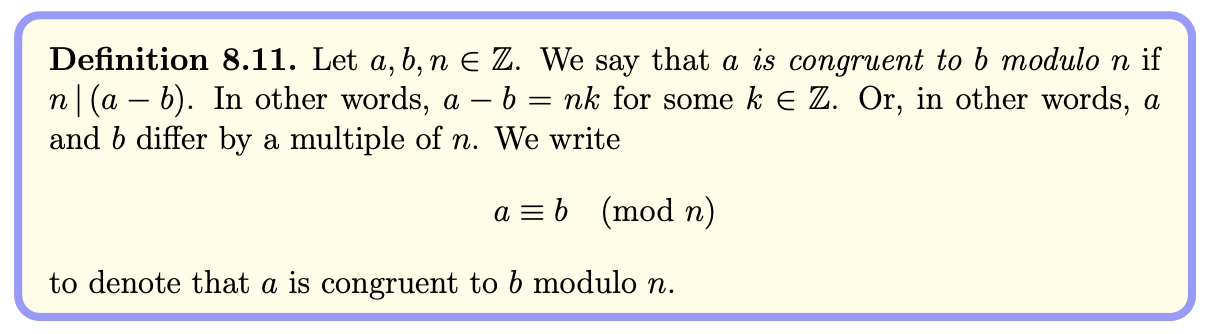
Congruence
In class practice
Proposition: If , then is even.
Proof: Let . We work directly. There are two cases.
Case 1: Assume that is even. Then for some . Hence
is even
Case 2: Assume that is odd. Then for some . Hence
is even.
In every case, is even.
Given , we have iff or .
Proof, let .
=> we work directly. Assume that . There are two cases.
Case 1. Assume that .
Case 2. Assume that . Then .
Proposition.
If , then (mod 3).
Proof. Let . We work directly.
Case 1: Assume that for some .
Then
Thus (mod 3).
Case 2: Assume that for some .
Case 3: Assume that fro some
HW 8
Ben Finch
E 8.1
Proposition:
Let . If and have the same parity, then is even.
Proof. Let and be integers. We work directly. There are two natural cases.
Case 1:
Suppose and are odd. Thus , for some . We find
is an even integer.
Case 2:
Suppose and are even. Thus , for some . We find
is an even integer.
Thus, in every case is even when and have the same parity.
E 8.2
Proposition. Let . If , then and
Proof. Let . We work contrapositively. There are two natural cases.
Case 1:
Suppose . Thus for some . So, . Since , we find .
Case 2:
Suppose . Thus for some . So, . Since we find .
Thus, for all cases, If , then and
E 8.3
a) Proposition.
If , either (mod 4) or (mod 4).
Proof:
Let . We work directly. There are two cases.
Case 1: Suppose that is even, thus for some . Then
Thus, so .
Case 2: Suppose that is odd, thus for some . Then
Thus, so .
So, in all cases, or .
(b)
Proposition: If , then .
Proof:
Let . We have two cases. We work directly.
Case 1: Suppose is even, thus for some . We find
Since is an integer, it follows that when is even.
Case 2: Suppose is odd, thus for some . We find
Since is an integer, it follows that when is odd.
Thus, in all cases, .
E 8.4
Proposition. Let . If (mod ) and (mod ), then (mod ).
Proof. Let . We work directly.
Assume (mod ) and (mod ), hence for some and for some . We find
Since is an integer, we have (mod ).
If we know 11 ≡ −3 (mod 7) and −3 ≡ 4 (mod 7), can we say that 11 ≡ 4 (mod 7)?
Based on this proof, yes, we can say that (mod .
E 8.5
Proposition: For any , if and only if .
Proof:
(=>) We work directly. Assume . Thus for some . We find
Since is an integer, we have .
(<=) We work contrapositively. Assume . There are two cases:
Case 1:
Suppose for some . We find
is not a multiple of three. Hence we have .
Case 2:
Suppose for some . We find
is not a multiple of three. Hence we have .
In both cases, if 3 does not divide , then does not divide . Therefore, we have shown that if , then .
In conclusion, we have proved that if and only if .
E 8.6
Proposition: Let , if and only if .
Proof:
Let .
(=>) We work contrapositively. Assume . Thus for some . We find
is not a multiple of 3. Thus we have .
(<=) We work directly. Assume . There are two cases:
Case 1:
Suppose for some . We find
is a multiple of 3. Thus we have .
Case 2
Suppose for some . We find
is a multiple of 3. Thus we have .
Thus we have for all cases.
In conclusion, we have proved if and only if
E 8.7
Proposition: Let . If (mod ) and (mod ), prove that (mod ).
Proof:
Let . Assume (mod ) and (mod ). Thus we have for some and for some . We find
is a multiple of . Thus we have (mod ).
What does this statement say if we take c = a and d = b?
Simplified, it would say if (mod ), then (mod ).
We know that (mod 7). Do we then know (mod 7)? Yes.
How about (mod 7)? No, not based on this proof.
E 8.8
Proposition: Let . Then .
Proof: We work directly. There are four cases.
Case 1
Suppose and . In this case, , and . We find . So,
Case 2
Suppose and . Then , and . So, .
Case 3
Suppose and . Then , and . We find . So, .
Case 4
Suppose and . This case is similar to case 3, thus
Thus, in all cases, .
E 8.9
Proposition: if and only if
Proof. Let . We work directly.
() Assume . There are two cases:
Case 1: Suppose :
We have and . From fact (1), if and , then .
Case 2: Suppose :
We have and . From fact (2), if and , then .
Therefore, in both cases, the assertion holds.
() Assume . There are two cases:
Case 1 Suppose :
Since and , it follows that .
Case 2 Suppose :
Then and ; therefore, .
Therefore, in both cases, the assertion holds.
Hence, if and only if .