Find an element in the set. When working with existence qualifiers, use "fix", "put", or "set" instead of "let" - which is used for an arbitrary value.
If is continuous, then for any satisfying or , there exists such that .
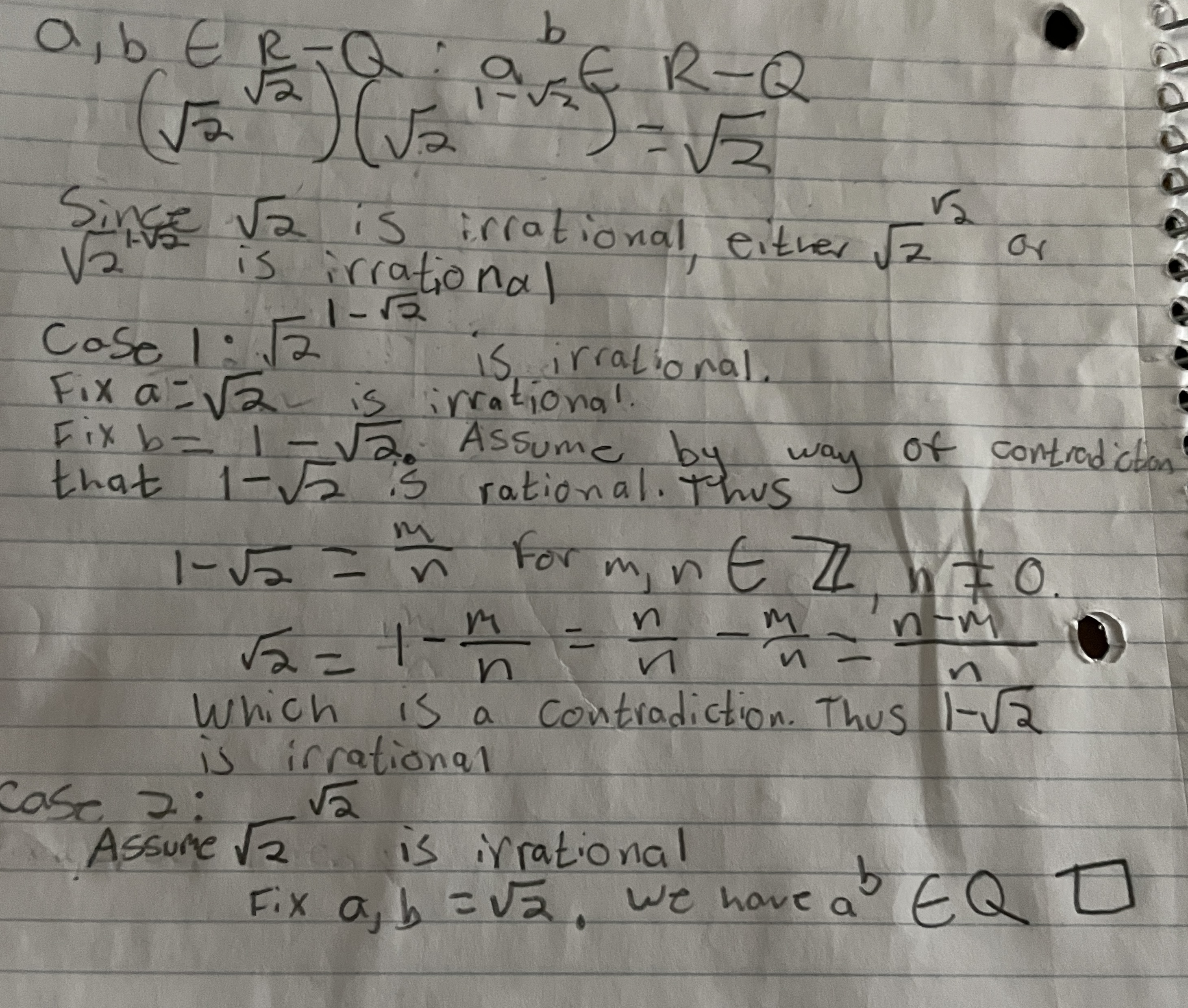
Nonconstructive existence proofs
Uniqueness
It's common to write .
In class practice
Proposition. Every odd integer is the sum of two consecutive integers.
Proof. Let . Thus for some . That is , and so is the sum of two consecutive integers and .
Proposition. The equation has a solution in the interval (0, 1).
Proof. The function is a polynomial, and thus continuous everywhere. We find that and . By the intermediate value theorem, we know that must take the intermediate value 0 for some .
HW 11
Ben Finch
E 11.1
a) Fix . Then . We have .
b) Fix , . Then . We have .
c)
d) Fix . Then and . We have .
e) Fix . Then and . We have .
f) Fix . Then and . We have .
g) Fix . Then and . We have .
E 11.2 Disproof. Fix and . We have .
E 11.3 Disproof. Fix . Thus
E 11.4 Disproof. Let . We work directly. There are two cases:
Case 1: Suppose is odd. Thus for some . We find
is even.
Case 2: Suppose is even. Thus for some . We find
is even.
Hence we have for all cases that , if is odd, then is even.
E 11.5
Lemma. We are trying to prove that a non-zero rational number times an irrational number is irrational. Let and where . Thus for some nonzero . Assume by way of contradiction that . Thus for some . We find
Since , which contradicts our original assumption that . Thus a nonzero rational number times and irrational number is irrational.
Proof. We work directly. Assume is a positive rational number. We can break this into two cases:
Case 1:. Thus a possible which is irrational.
Case 2:. Let . Per the lemma, is irrational. Also, is less than .
Thus in all cases, we have .
E 11.6
Proposition. Given any two real numbers and such that , we want to show that there exists a rational number in the interval .
Proof.
Let . Let . We can express in decimal form as . Since , there exists at least one decimal digit that is non-zero; let the first one be . Thus the value contributed by to is at least . Since is non-zero, we have .
So .
Multiplying the inequality by gives us .
Denoting as and as , we obtain .
Since and are more than 1 apart, there exists an integer such that .
Given that and , we have .
Rewriting this as and denoting as , we find that , where is rational since is a product of an integer and a rational number.
Hence, for all real numbers and such that , there exists a rational number in the interval .