20 - Properties of relations

!Screenshot 2023-10-24 at 9.46.44 PM.png
!Screenshot 2023-10-26 at 7.18.32 PM.png

In Class Practice

Def: Let R be a relation on a set A.

FOR ALL they have to hold true

  1. We say that R is reflexive if ∀a∈A,aRa
  2. We say that R is symmetric if ∀a,b∈A,aRb⟹bRa
  3. We say that R is transitive if ∀a,b,c∈A,((aRb)∧(bRc))⟹(aRc)
  4. We say that R is antisymmetric if ∀a,b∈A,((aRb)∧(bRa))⟹a=b

Example:
A = {1,2,3,4}
R =


HW 20

Ben Finch

E 20.1
a) a = 1, b = 2
b) a = 1, b = 5
c) S1={1,2,3,4}
S2={3,5,6}
S3={5}
S4={5,6}
S5=∅
S6=∅
d)
T1={1}
T2={1}
T3={1,2}
T4={1}
T5={2,3,4}
T6={2,4}

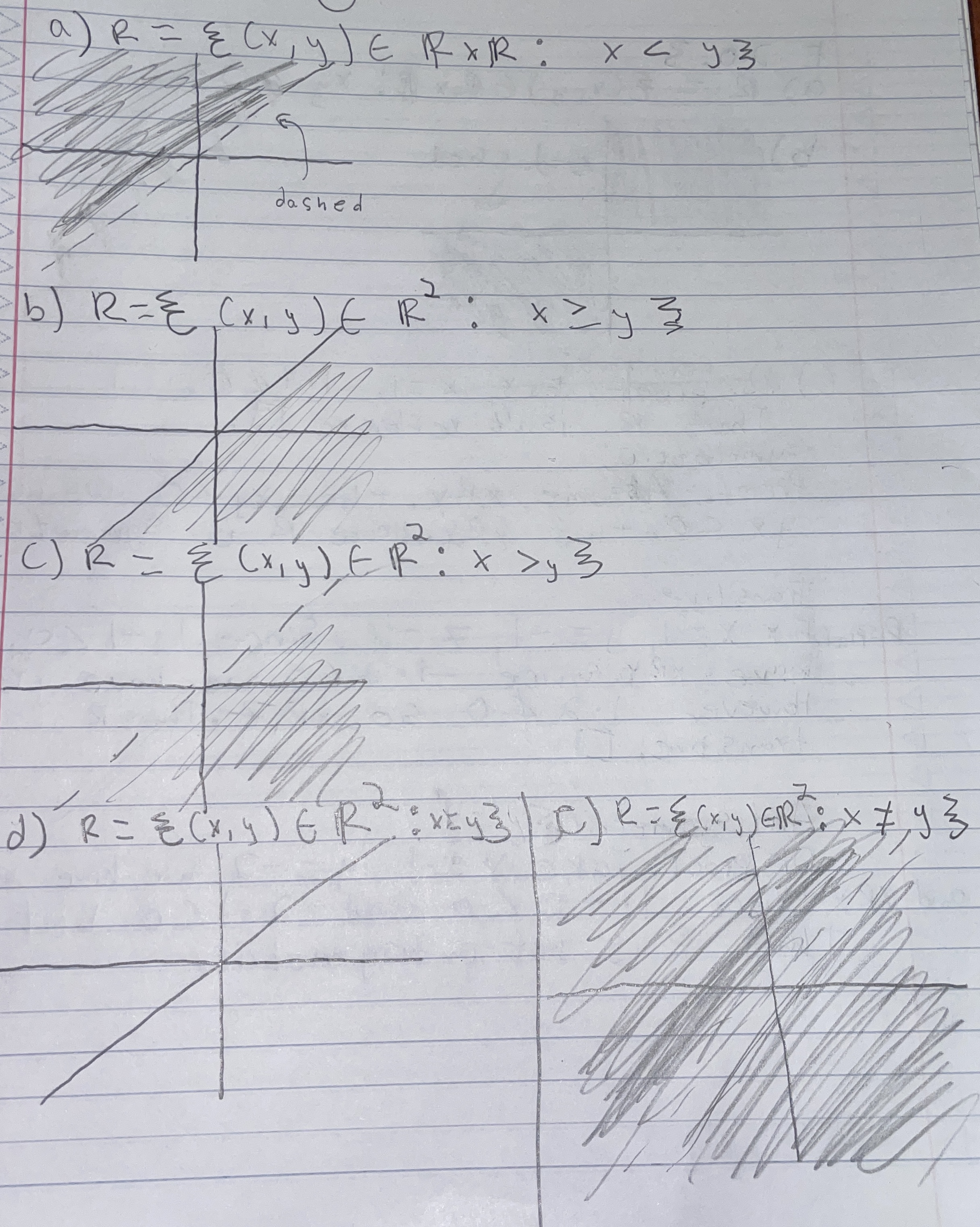
E 20.2
IMG_4144.jpg

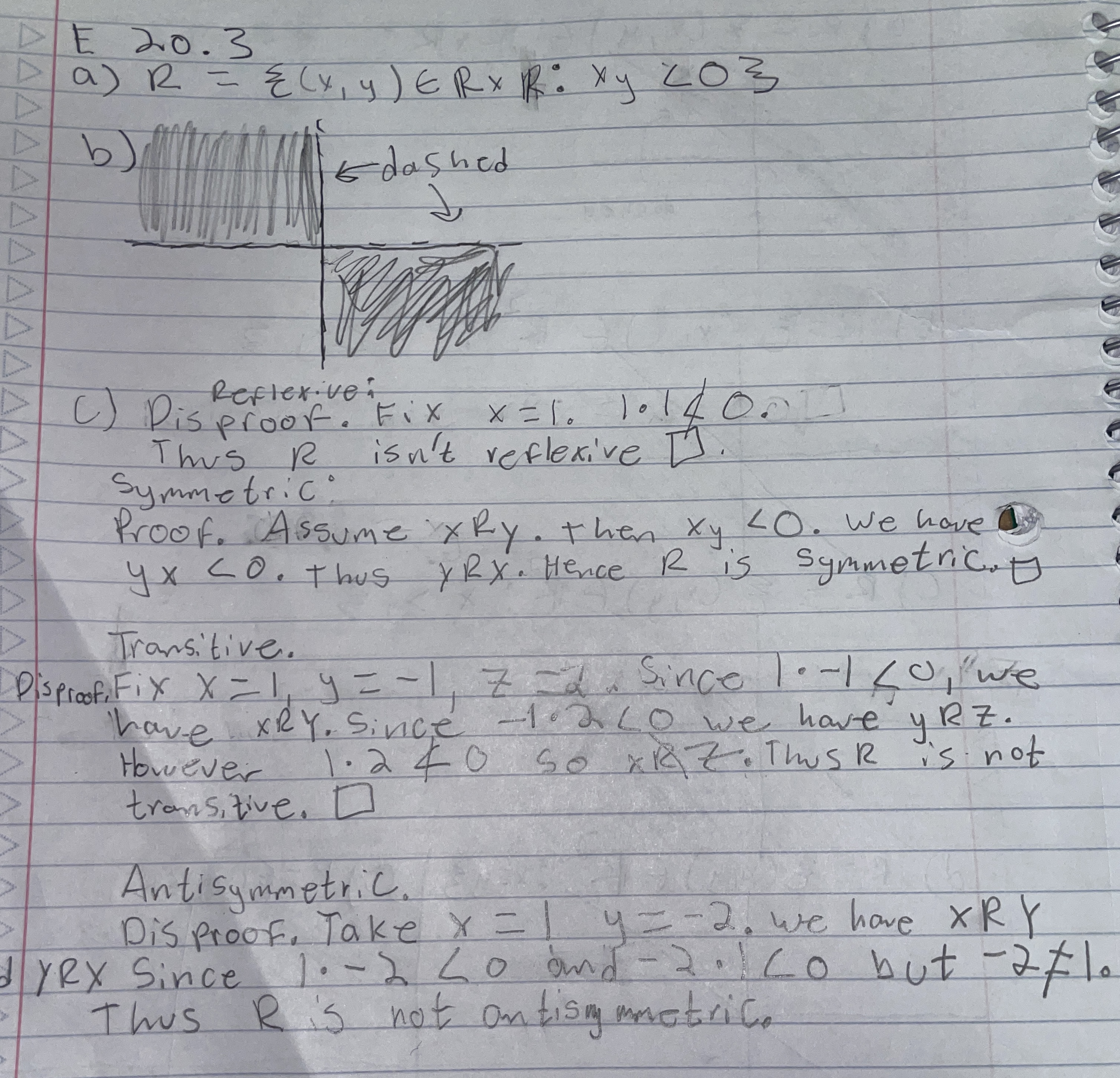
E 20.3
IMG_4148.jpg

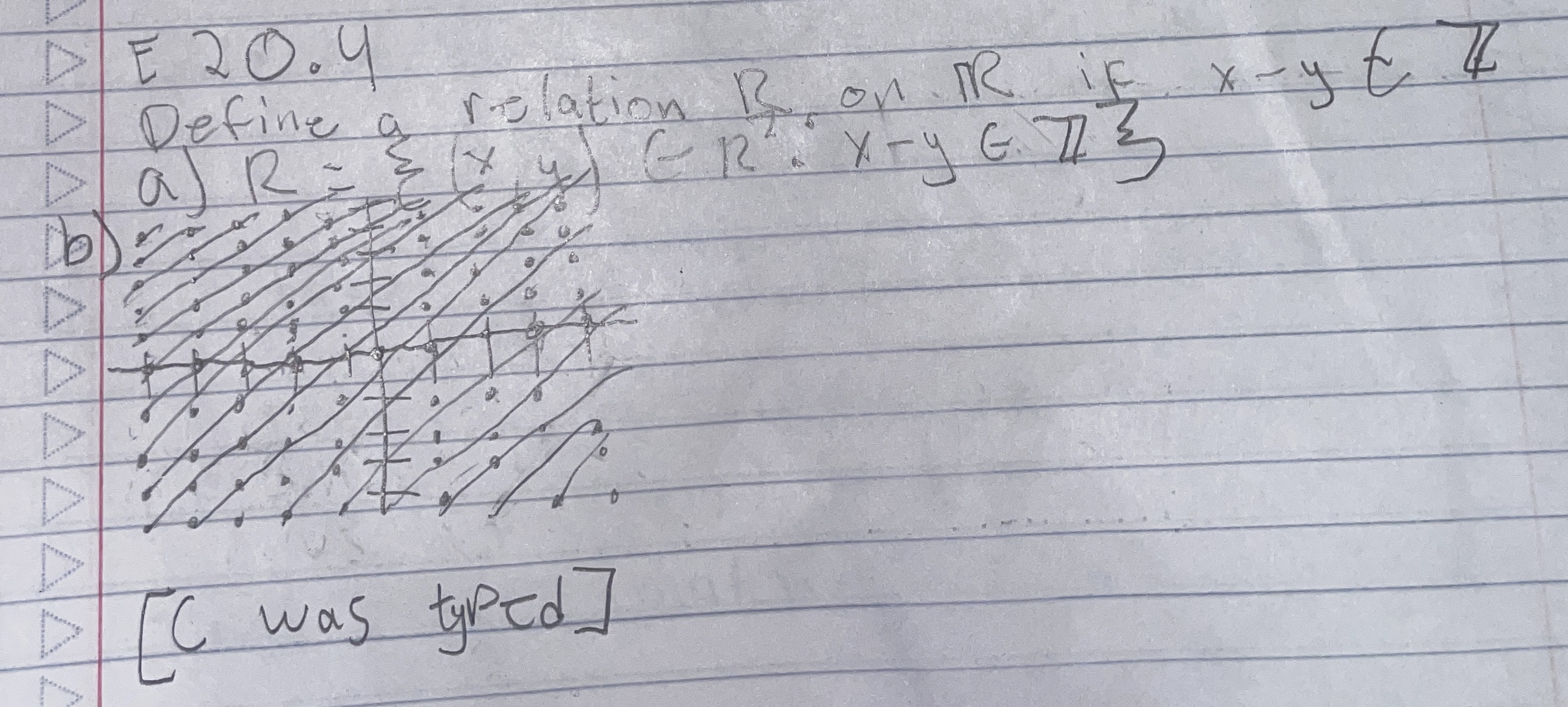
E 20.4
IMG_4146.jpg

c)
Reflexive.
Proof. Assume x∈R. Then x−x=0∈Z so xRx. Thus R is reflexive. ◻

Symmetric.
Proof. Assume xRy. Then x−y∈Z. Thus −(x−y)=y−x∈Z. Hence R is symmetric. ◻

Transitive.
Proof. Assume xRy and yRz. Then x−y∈Z and y−z∈Z.
This implies that (x−y)+(y−z)=x−z∈Z, because the sum of two integers is always an integer. Hence, xRz. So, R is transitive. ◻

Antisymmetric.
Fix x=−1 and y=0. We have xRy since −1−0∈Z and yRx since 0−(−1)∈Z but −1≠0. Thus R is not reflexive.

E 20.5
a) {(a,b) ∈ Z2 : a−b=2k for some k∈Z}.
b)
Reflexive.
Proof. Assume x∈Z. Then x−x=2(0). Thus xRx. Thus R is reflexive. ◻

Symmetric.
Proof. Assume aRb. Then a−b=2k for some k∈Z. Thus −(a−b)=b−a=2(−k). So bRa. Hence R is symmetric. ◻

Transitive.
Lemma. Let x,y∈EVEN. Then x=2k,y=2z for some k,z∈Z. Then x−y=2k−2z=2(k−z). Hence the difference of two even integers is even. ◻

Proof. Assume aRb and bRc. Then a−b∈EVEN and b−c∈EVEN. Thus (a−b)−(b−c)=a−c is even since the difference of two even integers is even per the lemma. Thus we have aRc. Hence R is transitive. ◻

c)
Fix a=4, b=2. We have aRb and bRa since 4−2=2∈EVEN and 2−4=−2∈EVEN but 4≠2. Thus R is not antisymmetric ◻

d) Any integers such that 1 (mod 2)

E 20.6
a) R =

b) R =

c) R =

d) R =

e) R =

f) R =

g) R =

h) R =

E 20.7
a) $$R ={(1,1), (2, 2), (3, 3), (1, 2), (1, 3), (2, 1), (2, 3), (3, 1), (3, 2), (3, 4), (4, 4), (4, 3), (5, 5)}$$
b)
Reflexive.
Proof. R is reflexive since (1,1), (2,2), (3,3), (4,4), and (5, 5) are in R. ◻

Symmetric.
Proof. Since we find (b, a) for all elements (a, b) in R, R is symmetric. ◻

Transitive.
Disproof. Fix a = 1, b = 3, c = 4. We have aRb and bRc since (1,3)∈R and (3,4)∈R. However (1,4)∉R, so aR̸c. Thus R is not transitive.

E 20.8
a)

R={(1,1),(2,2),(1,2),(2,1),(4,4),(5,5),(5,4),(4,5)}

b)
Reflexive. Disproof. Fix a = 3. We see 3∈A but not 3R3 since (3,3)∉R. Thus R is not reflexive.

Symmetric.
Proof. Since we find (b, a) for all elements (a, b) in R, R is symmetric. ◻

Transitive.
Proof. For every pair (a, b) and (b, c) in R, (a, c) is also in R. Thus, we can conclude that R is transitive. ◻