is one of the cities {cities with roads to } {cities with roads coming from }
Proof. We wish to prove the open sentence: for some , such that , ,
We work by induction.
Base Cases:
We see that
24 = 5(2) + 7(2)
25 = 5(5) + 7(0)
26 = 5(1) + 7(3)
27 = 5(4) + 7(1)
28 = 5(0) + 7(4)
Inductive Step.
Let , Assume that is true for all .
We aim to prove is true. By assumption, is true. That means there are integers such that . Hence
Since and we is true thus by mathematical induction P(n) is true for all .
HW 15
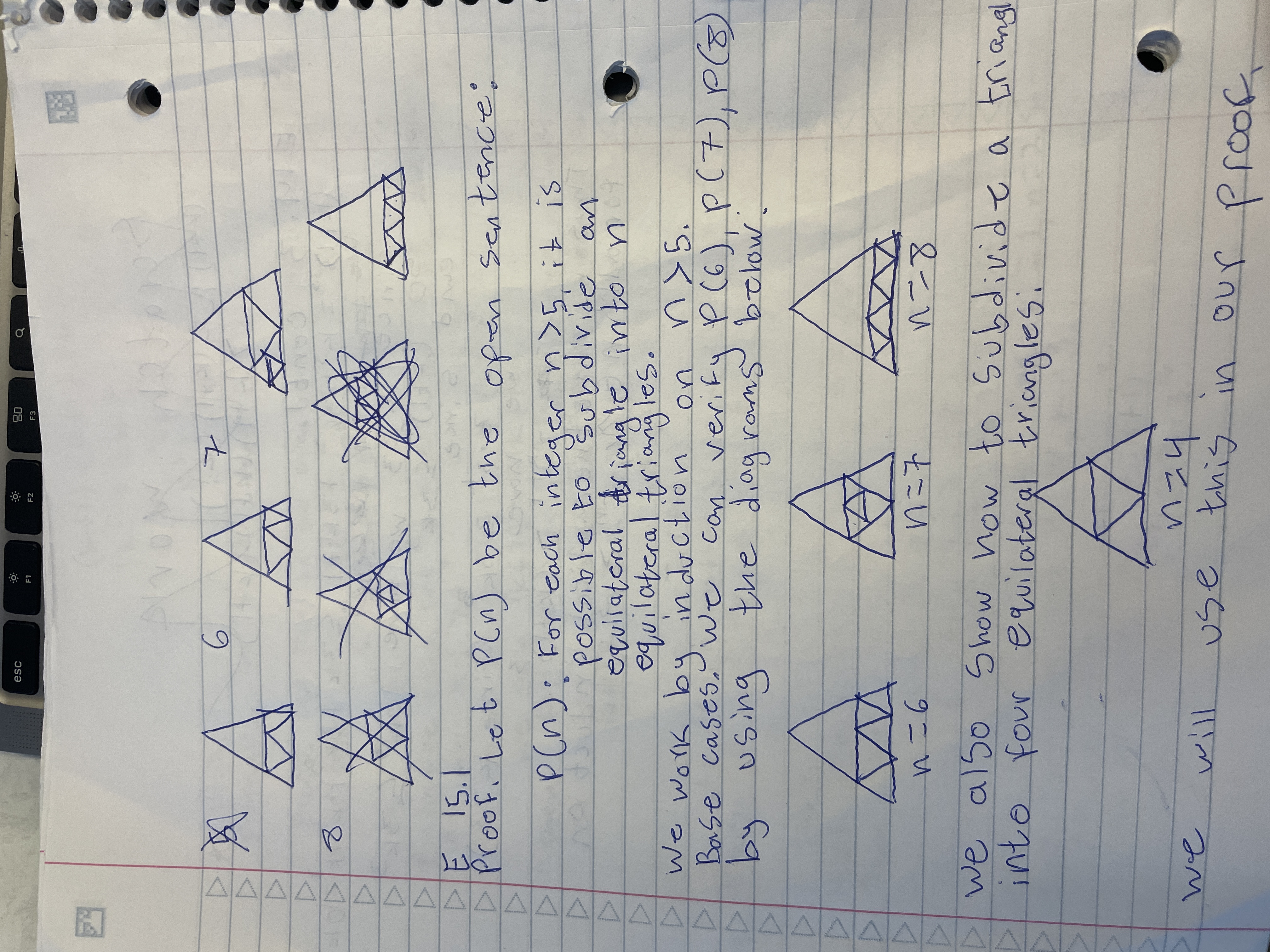
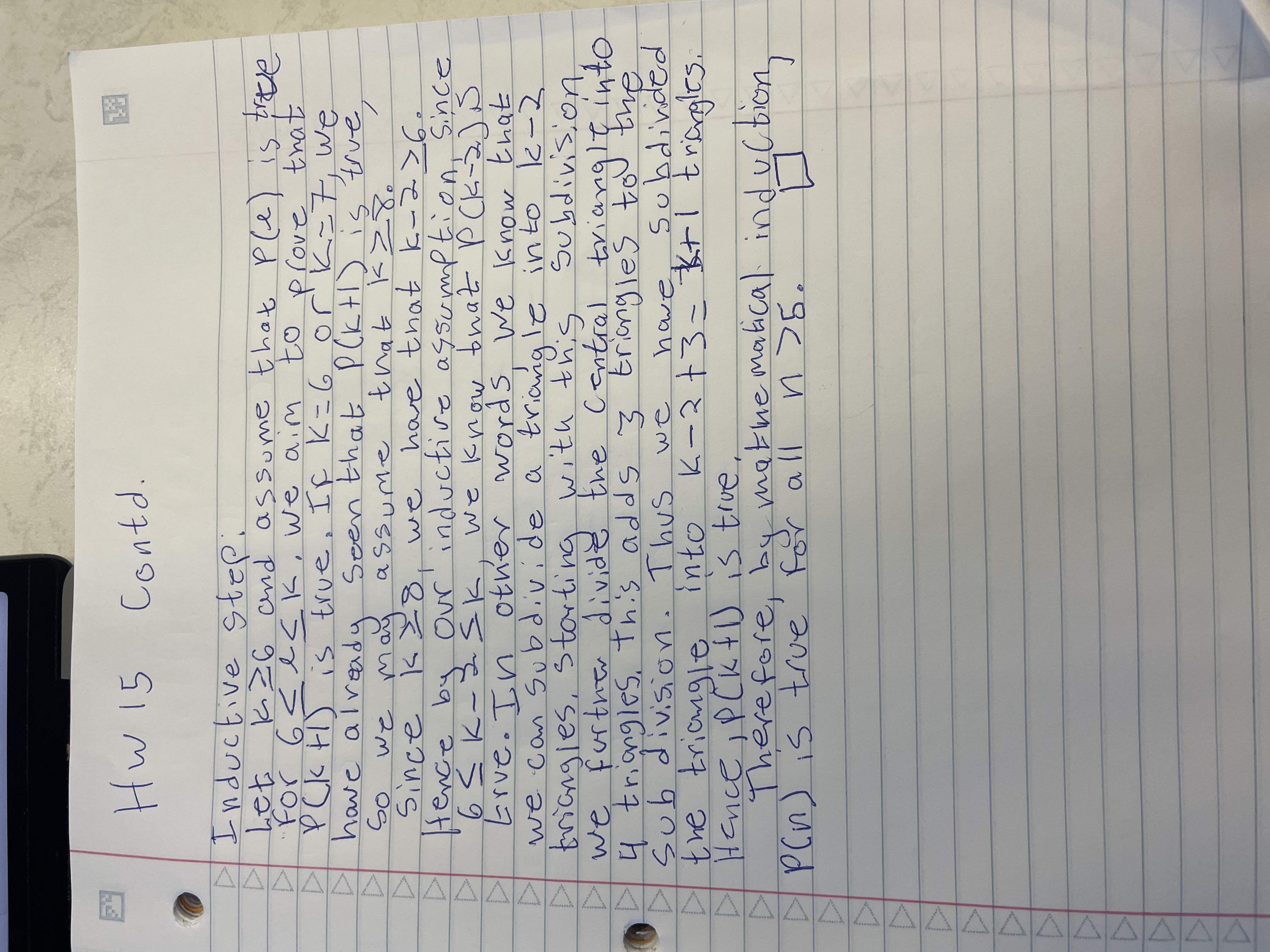
E 15.1
E 15.2
A --> C --> B --> D --> E --> F --> G --> H --> I
E 15.3
a) Proof:
We wish to prove the open sentence:
for some such that , where may depend on .
Base Cases:
We see that
14 = 3(2) + 8(1)
15 = 3(5) + 8(0)
16 = 3(0) + 8(2)
Hence P(14), P(15), P(16) are true.
Inductive step:
Let . Assume is true for all .
We aim to prove is true. By assumption is true. This means that there are integers such that . Thus
Since and we see is true. Thus, by mathematical induction is true for all .
b)
Assume by way of contradiction that for some nonnegative integers .
Since are nonnegative, when
Thus . Thus
Since are nonnegative, when . . So . Thus
We have 8 cases remaining:
For , , the equation becomes , which is not true.
For , , the equation becomes , which is not true.
For , , the equation becomes , which is not true.
For , , the equation becomes , which is not true.
For , , the equation becomes , which is not true.
For , , the equation becomes , which is not true.
For , , the equation becomes , which is not true.
For , , the equation becomes , which is not true.
None of these combinations equal , implying that for nonnegative integers , cannot be expressed as . Thus we have reached a contradiction.
Hence, we conclude that cannot be written as for any integers .
E 15.4 Proof. Let . We wish to prove the open sentence:
for some , where may depend on .
Base Cases:
We see
Hence P(1) and P(2) are true.
Inductive step:
Let , . Assume that is true for all . We aim to prove is true.
There are two cases: Case 1: even
If is even, then we can write for some , .
By the inductive hypothesis, we know that can be written in the form for some , .
Therefore, , where .
So, is true when is even.
Case 2: odd
If is odd, then we can directly write .
Since is odd, .
Therefore, is also true when is odd.
Hence, by mathematical induction, the statement is true for all .
E 15.5 Proof:
Let , . We wish to prove the open sentence: where , and may be dependent on .
Hence, P(22), P(23), P(24), P(25), P(26), and P(27) are true.
Inductive step:
Let . Assume is true for all .
We aim to prove is true. By assumption, is true. This means that there are integers such that . Thus
Since and we see is true. Thus, by mathematical induction is true for all .
Since all amounts greater than 21 cents can be paid with 4, 10, and 15 cent stamps the largest amount that cannot be paid is 21 cents.
E 15.7 Proof.
Base Cases:
Consider the numbers 1, 2 and 3.
1 is itself a Fibonacci number.
2 is also a Fibonacci number.
3 can be written as the sum of two Fibonacci numbers (2 + 1).
Inductive Case:
Assume that every number can be written as a sum of distinct Fibonacci numbers. We want to show that this is also true for the number .
To do that, we find the largest Fibonacci number, , that is less than or equal to . According to the properties of Fibonacci numbers, we know that .
We can express as .
If , then is already a Fibonacci number.
If , then is a positive integer less than .
By our inductive hypothesis, we can represent any number less than as a sum of distinct Fibonacci numbers. Therefore, can be written as a sum of Fibonacci numbers, each of which is smaller than .
Thus, every number up to and including can be expressed as a sum of distinct Fibonacci numbers. By the principle of mathematical induction, every positive integer can be expressed as a sum of distinct Fibonacci numbers.