If the set is described using set builder notation, we have to prove a number meets all the conditions to be in the set.
For example:
It should be within the stated domain (for example, ).
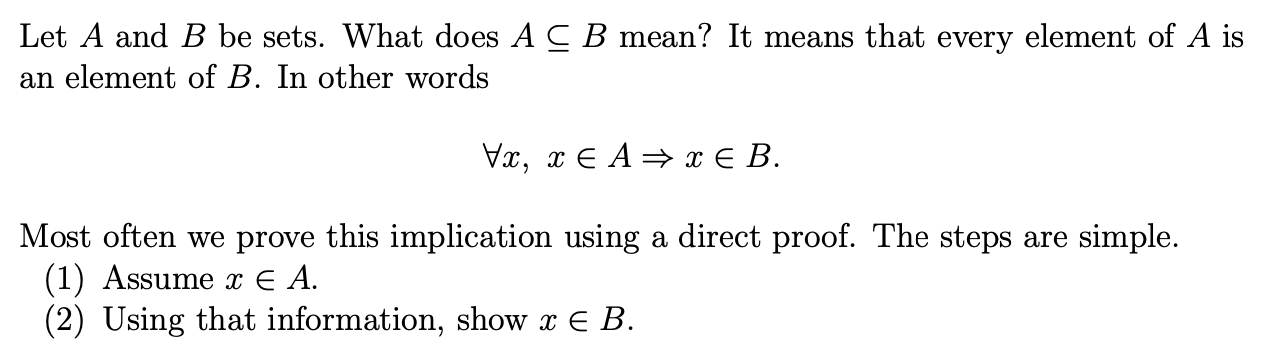
Proving Inclusion of Sets
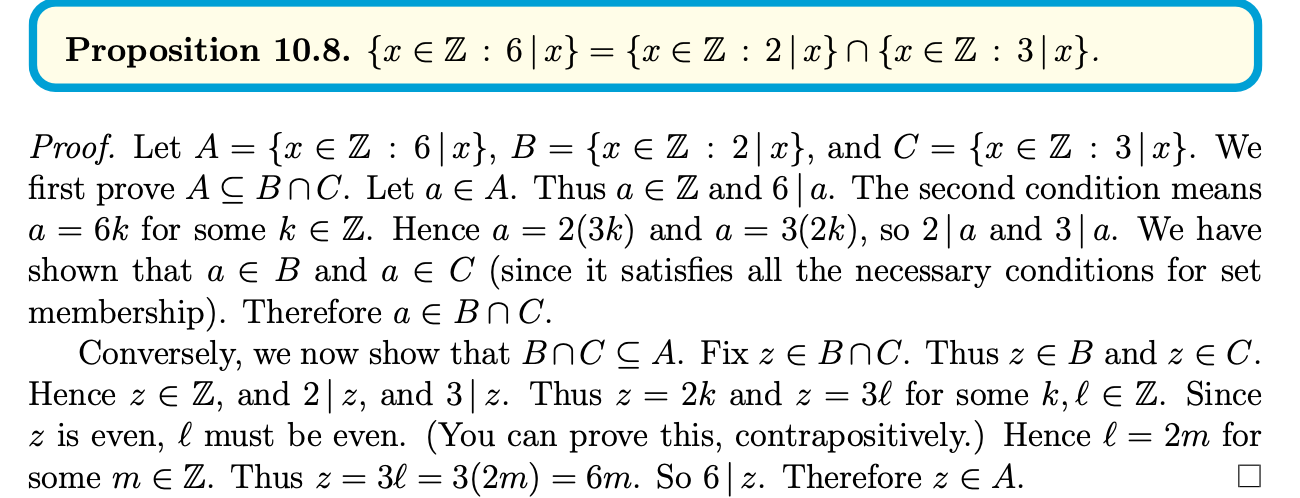
Proving Equality
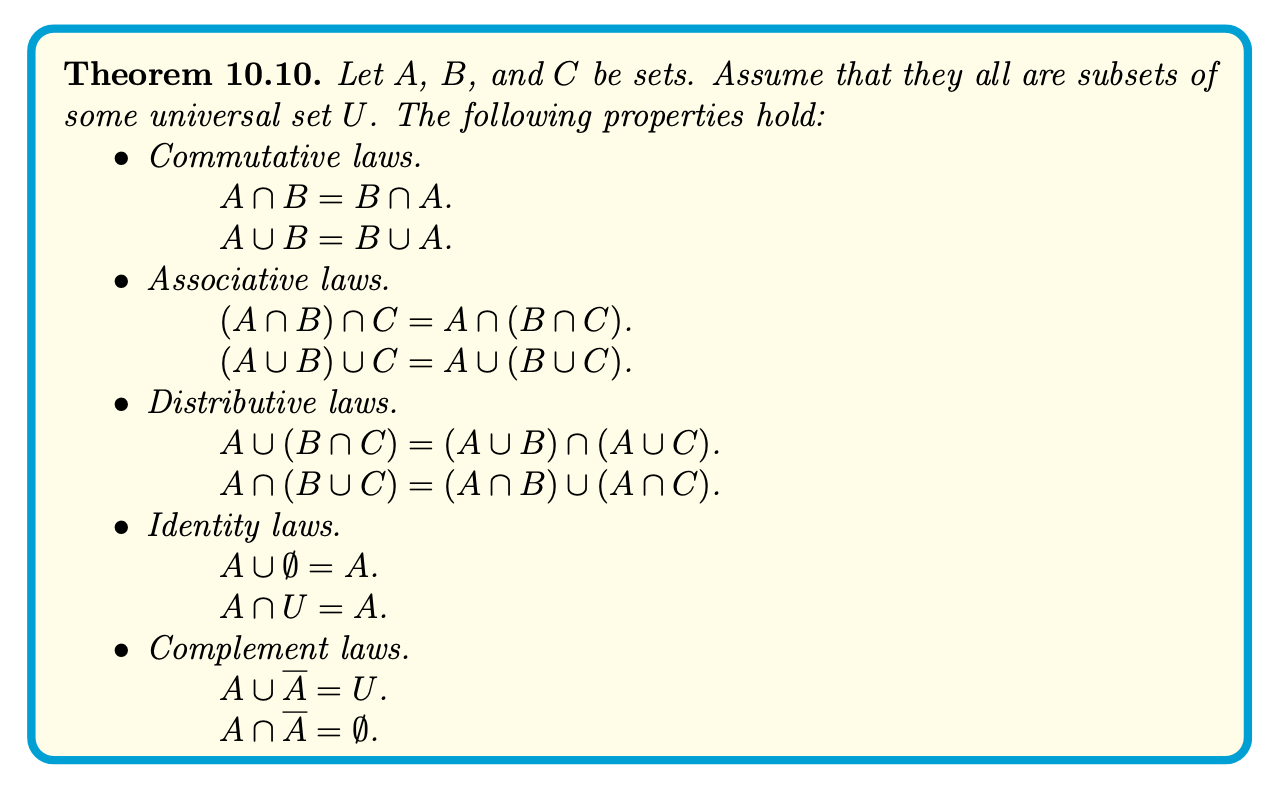
Laws of sets
In class practice
We work directly. Let and . It holds that . Assume . Thus for some . Hence . Thus . Thus .
HW 10
Ben Finch
E 10.1
a) Yes, 3 is one of the elements listed in the set.
b) No is not one of the elements listed in the set.
c) Yes, is a real number.
d) Yes, is a real number and .
e) No, .
E 10.2 Proof: Assume . Thus x and . Hence = for some . There are two cases:
Case 1. Suppose is even. Thus for some . We find
Hence, is also an even integer.
Case 2. Suppose is odd. Thus for some . We find
Hence, is also an odd integer.
In all cases and share the same parity. Thus satisfy all conditions to be part of set . Hence, .
E 10.3 Proposition:
Let X be the set of integers which are congruent to −1 modulo 6 and let Y be the set of integers which are congruent to 2 modulo 3. Prove X ⊆ Y.
Proof:
We work directly. Assume . Thus and for some . Now consider some . Thus and for some . We find
The above expression confirms that can be written in the form where , which is the definition of the set . Therefore, . Thus, we can conclude that for all , , and therefore .
E 10.4
(a) Let . This means that . Hence, and , which is equivalent to or . So, .
Therefore, .
(b) Proof that :
Let . This means that or , which is equivalent to or . Hence, and therefore, .
Therefore, .
(c) We have proved that since they are subsets of each other.
E 10.5
Let . We want to prove that .
We have: , which means that and . Thus or . Since we've already established that , the latter must be true: .
Therefore, since and , we have .
E 10.6
Assume .
This means that or . However, the latter is not possible since the empty set has no elements.
Therefore, must be true. Hence, this implies that .
E 10.7
Let .
Let . This implies . By definition, there exists an integer such that . This is equivalent to . Thus .
Let . This implies . By definition, for some integer , which means . Thus .
Therefore, .
E 10.8
Prove that
Proof: Let be sets.
Let . Thus and . Hence and . There are two cases:
Case 1: . Then . Then , so
Case 2: Then , so .
E 10.9
Proof:
(1)
By definition of the sets , every element in each set is an integer. Hence, every element in the union of all is also an integer, proving that .
(2)
We have two cases:
If is non-negative, then since . Therefore, belongs to .
If is negative, then for any since . Therefore, belongs to .