A theorem is an important statement we prove. We will only name results “Theorems” when they are extremely important.
A proposition is a basic statement we prove.
A lemma is a (usually minor) result that we prove in order to use it later to prove a bigger result. We use lemmas as a way of breaking up large proofs into smaller, more understandable pieces.
A corollary is a (usually minor) result that follows easily from another result we have proved.
Conjecture - we think this is true but we don't know
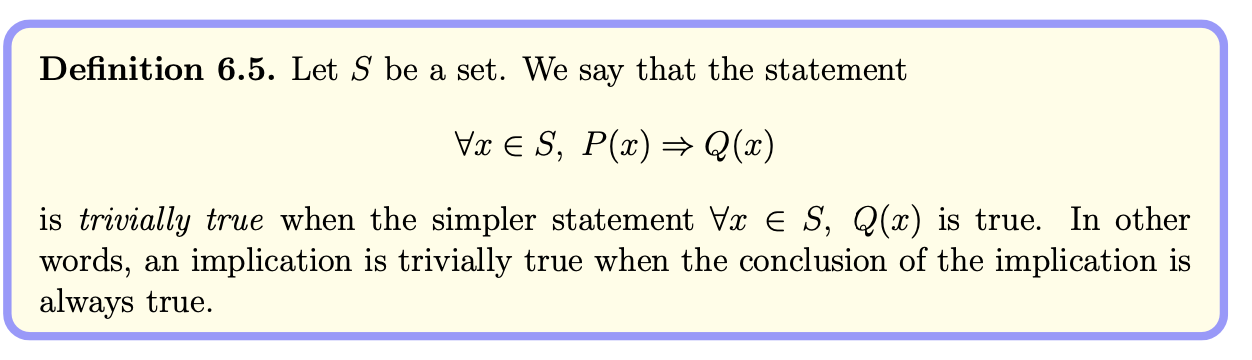
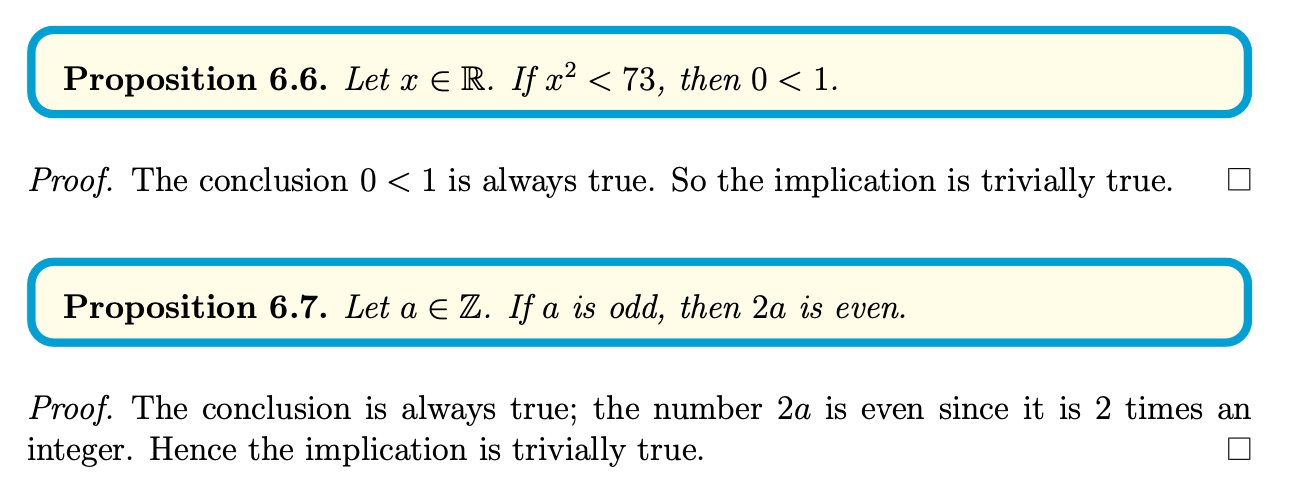
Trivial Proofs
A proof is trivially true when the premise of the implication is irrelevant. A square box indicates the proof is over.
Sometimes “trivial” proofs are not easy and take some work to prove.
It is always a good idea to understand the premise and conclusion of an implication separately before trying to prove the implication.
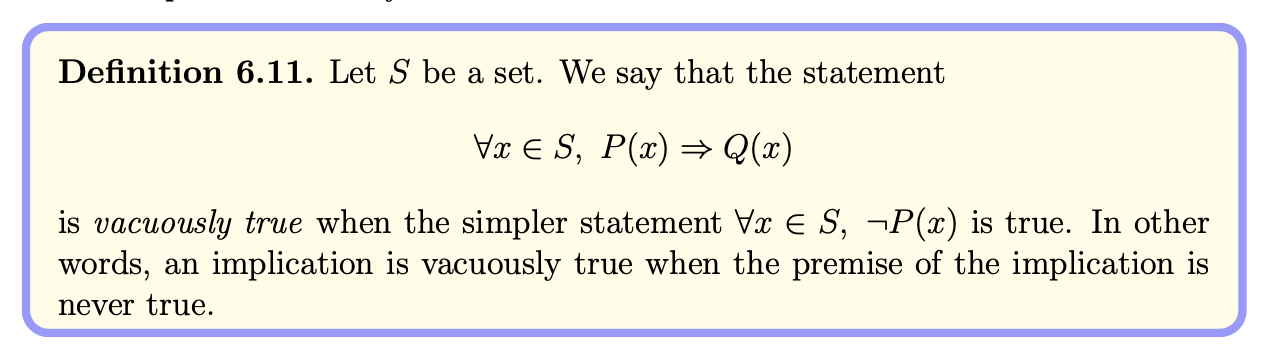
Vacuous proofs
If the premise is impossible, the implication is vacuously true.
Trivial, the Q is true. Vacuous, the premise is bogus.
Trivial and vacuous proofs should come from implications
Outline of a direct proof
Given a statement , we can prove it directly by assuming the premise holds and then, using that information, we show that must also hold true.
Example:
Proposition. For each , if is even, then is odd.
Proof. Let be arbitrary. We will work directly. Assume x is even. This means
for some . Thus
Since , this means that is odd.
Basic outline:
Given , if is true, then is true.
Proof outline.
Let x ∈ S.
We work directly.
Assume P(x).
Do some work (to be filled in). Thus, Q(x) holds.
Write the conclusion before filling in the middle.
In class practice
Proposition.
Let If then . Proof.
The inequality is always true, so the proposition is trivially true.
Proposition.
Let . If is odd, then is even. Proof.
Since is always even for all integers, the proposition is trivially true.
Proposition.
Let . If , then . Proof.
The inequality is equivalent to which is true for all , therefore, the result is trivially true.
Proposition: For each , if is even, then is odd.
Proof:
Let .
We work directly.
Assume that . Thus for some .
We find
Since is an integer, is odd.
Proposition: If is an odd integer, then is even.
Proof: Let . We work directly. Assume that is odd. Thus for some . Hence
We find
Since is an integer, is even.
HW 6
Ben Finch
E 6.1 Proposition. Let . If , then
Proof.
The equation is the same as
Since is always non-negative for the domain , is always positive. This claim is trivially true since the implication is true for all real numbers .
Thus .
E 6.2 Proposition. Let . If , then is odd.
Proof.
Since is a natural number, there are no values for that satisfy the condition of the proposition. Thus, the claim is vacuously true.
E 6.3 Proposition. If is an odd integer, then is odd.
Proof.
Let .
We work directly.
Assume is odd. Thus for some .
We find
represents an integer, for example , so we can rewrite this expression for as , which is the definition of an odd number.
Thus, if is an odd integer, then is odd.
E 6.4 Proposition. If is an even integer, then is odd.
Proof.
Let .
We work directly.
Assume is even. Thus for some .
We find
Since represents an integer, for example , we can write the expression for as which satisfies the definition of an odd number.
Thus, if is an even integer, then is odd.
E 6.5 Proposition. Let . If and are odd, then is even.
Proof.
Let .
We work directly.
Assume and are odd. Thus for some .
We find
Since both and are integers, is also an integer, so we can rewrite the expression as , where represents some integer, which satisfies the definition of an even number.
Thus, If and are odd integers, then is even.
E 6.6 Proposition. Let . Prove that if , then is an even integer.
Proof.
Let .
We work directly.
Assume . Thus .
We find that , which is an even integer.
Thus if , then is an even integer.
E 6.7 Proposition. Every odd integer is a difference of two squares of integers.
Proof.
We can rewrite the proposition as an implication:
If is and odd integer, then where is an even integer and is an odd integer.
Let .
We work directly.
Assume . Thus for some .
We find that
Thus, If is and odd integer, then where is an even integer and is an odd integer.